King of Swords: tarot meaning
Minor Arcana · logic · authority · principle
Upright
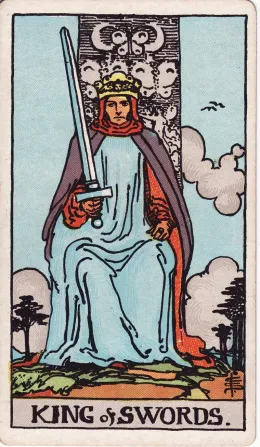
The king raises his sword as the final word, calm on a throne carved with butterflies and birds. He decides by principle rather than mood, and invites you to sort the facts from the noise before you rule.
Reversed
Reason is being used as a weapon, or as armor against feelings that refuse to stay filed away. Even airtight logic deserves an occasional audit of what it is protecting.
What the card shows
A crowned judge is enthroned with a bare sword held up — the suit's emblem drawn, not sheathed. The image echoes the Justice figure among the Trumps Major, yet he stands for something weightier than the virtue itself: by virtue of his office, the authority to end lives. Nothing in his posture suggests rage; the blade is an instrument of judgment, the badge of a man whose word decides. The card reads as intellect enthroned — decision-making made official, ruling with force precisely because appeal is hardly possible.
Description based on the 1909 edition, in the public domain.
In love
Feelings deserve structure too. This king brings the same order to emotional matters as to contracts: what was agreed, what changed, what each person needs going forward. A family disagreement or a partner negotiation benefits from his calm, principled approach — rules stated plainly, applied to yourself first. With him, fairness is a form of care.
At work
Decide from evidence, not volume. This king favors the person who arrives with the facts sorted: the meeting where you have already separated evidence from opinion beats the loudest voice in the room. If a call is yours to make, make it cleanly and state the reasoning; if it is not, present the case and let go.
The card’s advice
Reduce one matter swirling with opinions to three verifiable facts and one decision, on paper, before discussing it with anyone. Facts written down resist re-inflating into drama.
In a yes or no question
Upright, the answer comes from the facts and is yes if the facts support it: strip the question of preference and fear, and what remains is the verdict. If you cannot get to yes on the evidence alone, the answer is no. Reversed, judgment is being bent, by you or by someone with authority over the matter, so treat any confident verdict with suspicion and ask whose interest it serves.
The card in a three-card reading
- In the past position
- A decision made by principle, yours or an authority's, set the terms you are still living under. It was likely correct and possibly cold. Understanding its logic now helps you work with it instead of around it.
- In the present position
- The situation calls for a ruling, not a discussion. Sort the facts from the noise, decide by principle rather than mood, and state the outcome once, clearly. People will accept a firm answer more easily than a warm maybe.
- In the future position
- A judgment is ahead, and it will reward preparation over persuasion. Get your facts in order before you are asked for them. The deciding voice, possibly yours, will favor whoever respects the evidence most.
Combinations with other cards
King of Swords + Justice
The throne and the Trump of the same idea reinforce each other. Together they describe a matter that will be settled strictly on its merits, by rules rather than relationships. The pair advises you to prepare your case the way the decision will be made: documented, ordered, and free of appeal to sympathy. Fairness here is a procedure, not a mood.
King of Swords + Ace of Swords
Authority meets the single clear idea it serves. This pairing often marks a moment when one precise truth cuts through a tangle of procedure and opinion. Read together, they suggest the right decision is simpler than the debate around it, and that the person willing to state it plainly will end up holding the sword.
Other cards
Text: Marina Vidal, tarot reader · How we write the meanings · Meaning of all 78 tarot cards