Justice: tarot meaning
Major Arcana · truth · balance · accountability
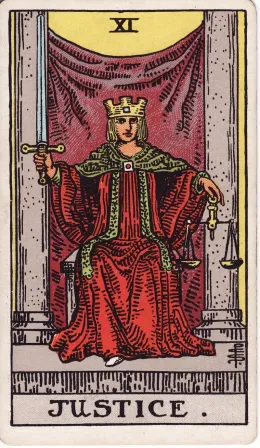
Upright
A raised sword and balanced scales, held by a figure who looks straight ahead. An honest accounting is due: weigh what actually happened, not the story you prefer.
Reversed
The scales have tipped toward harsh judgment, most often of yourself. Or the honest look keeps getting postponed — either way, truth delayed weighs more later.
What the card shows
A seated figure holds the balance between two pillars, in the direct line of the High Priestess though opening into a different world. The card carries its traditional symbolism plainly: the moral principle that deals to each person according to their works. Not mercy and not mystery — an honest scale of cause and consequence, kept level by attention rather than sentiment.
Description based on the 1909 edition, in the public domain.
In love
Honesty is this card's currency in relationships: saying what actually happened rather than a smoother version of it. If there is an imbalance — of effort, of listening, of apology — name it plainly. The card also asks you to weigh your own part fairly. Accountability given generously tends to be returned; scorekeeping tends only to be contested.
At work
Facts over narratives, including your own. Before deciding, write down what actually happened — numbers, dates, delivered versus promised. Justice favors documentation and clear terms: get the agreement in writing, review the contract, state the expectation. If a review or evaluation is due, meet it with evidence rather than a defense.
The card’s advice
Take one situation you keep arguing about in your head, write the plain facts of it with no interpretation, and read them once.
In a yes or no question
Upright, this card answers yes when the facts support you and no when they do not — it is the one card whose verdict you can audit. Weigh what actually happened rather than the story you prefer, and the answer is usually already visible. Reversed, the question tilts toward harshness or delay: the accounting keeps sliding. Do the honest sum sooner.
The card in a three-card reading
- In the past position
- An accounting was made — fair or harsh — and its verdict still shapes how you read the present. The card here asks whether that judgement was honest, and whether you have been serving it or quietly revising it.
- In the present position
- The moment calls for honest weighing. Set both sides of your question on the scale — what happened, what you contributed — and let the facts, not your preference, decide where the balance rests.
- In the future position
- This position points toward a reckoning ahead rather than a foretold result. How it lands depends largely on the record being built now; act in a way you would not mind seeing weighed later.
Combinations with other cards
Justice + The High Priestess
Her pillars open into one world, his into another — that contrast is the heart of the pair. Justice works by evidence and measure in the visible realm; the High Priestess by intuition behind a veil. Together they ask which court your question belongs in: the one where facts are weighed, or the one where what you already sense is allowed to speak.
Justice + Two of Swords
Justice weighs with full attention; the Two of Swords sits blindfolded before a decision, holding the balance and unwilling to read it. Paired, they frame a choice being postponed in the name of fairness. The reading is a prompt: the scales will not settle themselves, and avoidance is itself a verdict.
Other cards
Text: Marina Vidal, tarot reader · How we write the meanings · Meaning of all 78 tarot cards