The Hierophant: tarot meaning
Major Arcana · tradition · guidance · learning
Upright
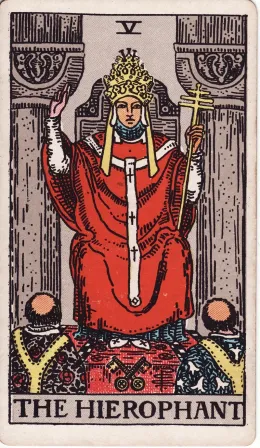
Two keys cross at his feet, and he teaches a path others have walked before. Turning to tradition, a mentor, or a proven method can steady you where invention would only add noise.
Reversed
The keys are yours now, and the inherited rulebook may not fit your life. Give yourself permission to keep what serves you and quietly rewrite the rest.
What the card shows
A crowned figure sits between two pillars — not the pair that stands in the temple of the High Priestess. His headgear has three tiers, and his left hand grips a staff whose upper end forms a triple cross. With his right hand he makes the church sign of esotericism, marking the split between what is taught openly and what stays hidden — notice, by contrast, that the High Priestess gestures nothing. Crossed keys lie at his feet, and two ministers in white albs kneel before him. You are looking at organized, outward religion in person.
Description based on the 1909 edition, in the public domain.
In love
Shared rituals hold couples and families together more than grand gestures do: the Sunday call, the meal everyone knows is coming. The Hierophant suggests borrowing what already works — ask a couple you admire how they handle the thing you struggle with. Where family expectations press on you, keep the ones that genuinely fit and set the rest down with respect.
At work
Learn from the people who have done this before. A course, a certification, a colleague with ten more years in the field — the proven path is faster than inventing your own under pressure. Ask the mentor question you have been embarrassed to ask. Institutions and established methods can feel slow, but they carry accumulated corrections you would otherwise rediscover the hard way.
The card’s advice
Reach out today to one person whose experience runs deeper than yours, and ask them a single specific question about your current challenge.
In a yes or no question
Upright, the answer leans toward yes when a conventional path applies — a proven method, a formal step, advice from someone further along. Confirm with tradition before improvising. Reversed, the inherited rulebook is the problem rather than the path: the yes appears only once you keep what serves you and rewrite the part that was never yours to follow.
The card in a three-card reading
- In the past position
- A tradition, a teacher or an institution shaped the ground under this question. The card here asks you to name that inheritance honestly: what of it still carries you, and what did you absorb without ever agreeing to it.
- In the present position
- The useful move now is to consult rather than invent. A proven method, a mentor, or a community that has walked this road before can steady you where fresh improvisation would only add noise.
- In the future position
- This position points toward a formal step or a return to an established path. Preparation looks like learning the rules of the road ahead of time, so the structure you meet later becomes a support rather than a surprise.
Combinations with other cards
The Hierophant + The High Priestess
He is external religion; she is the withdrawn, esoteric power — each is defined by the other. The Hierophant teaches in the open with crossed keys at his feet; the High Priestess sits before a veil. Together they frame your question as having a public, learnable side and a private, unteachable side. Honour both.
The Hierophant + The Emperor
Two thrones side by side: one of law, one of doctrine. The Emperor organises the world through structure; the Hierophant through meaning and shared practice. Paired, they suggest the situation calls for legitimate channels — a formal commitment, an official step, an established institution — rather than a private workaround.
Other cards
Text: Marina Vidal, tarot reader · How we write the meanings · Meaning of all 78 tarot cards