Six of Swords: tarot meaning
Minor Arcana · transition · moving on · gradual healing
Upright
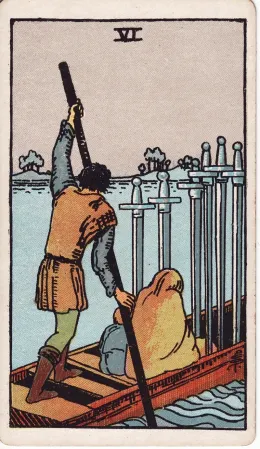
A quiet ferry carries a mother and child toward smoother water while the steersman keeps his back to the shore behind. Distance is already doing some of your healing for you; let it work.
Reversed
The boat drifts back toward the shore you left, often because unfinished feelings tether it there. You can visit the old ground in memory without unpacking your bags on it.
What the card shows
A ferryman poles a small punt across calm water, carrying passengers toward the further shore. The course is smooth, and the load is light enough that the work does not strain him. Everything in the scene points one way: away. The stillness of the water contrasts with whatever shore is being left, and the ferryman's steady, unhurried labor suggests that departure here is not flight but transport, a passage done properly. The card's landscape is mostly water and distance, which is why it reads as transition rather than arrival.
Description based on the 1909 edition, in the public domain.
In love
Some healing in love happens through distance rather than talk — the ex you stop checking, the family tension eased by a move, the friendship that recovers once you are not in the same room daily. Let the crossing continue instead of rowing back toward what was. New shores settle feelings faster than old ones do.
At work
A transfer, a new field, a project handed over: movement away from a difficult work situation is already underway, and the steersman in this image does not look back. Let the transition carry you rather than auditing every detail of the place you left. What you take with you matters more now than what you leave.
The card’s advice
Mute, for one week, the thing that keeps pulling you back to a place you decided to leave — the thread, the folder, the evening routine. See if the forward motion feels easier without the rope.
In a yes or no question
Upright, this is a quiet yes, especially for questions about moving on, relocating, or changing approach. The card favors gradual transitions over dramatic ones, so the yes comes with a condition: let the change be steady rather than sudden. Reversed, the answer stalls toward not yet, usually because something unsaid is keeping the boat near the old shore; say it out loud and the current turns.
The card in a three-card reading
- In the past position
- A difficult transition is already behind you, and it went more smoothly than it felt at the time. The distance you gained then is part of why the present looks manageable. Credit the move you made, even if it felt like retreat.
- In the present position
- You are mid-crossing right now, between a shore you have left and one you cannot yet see clearly. The water is calmer than your anxiety claims. Keep moving at the ferryman's pace; hurrying this stretch helps nothing.
- In the future position
- A gradual move away from a strained situation is ahead, and it will feel quieter than you expect. Do not mistake the calm for stagnation. Progress here is measured in distance from the old shore, not in speed.
Combinations with other cards
Six of Swords + Eight of Cups
Two cards of leaving, one by water and one on foot. Together they underline that the departure in question is real and necessary, not a mood. The pair also distinguishes the work: one card walks away from what failed emotionally, the other ferries what still matters to safer ground. You are allowed to do both at once.
Six of Swords + The Tower
Collapse followed by the crossing. This pairing often appears when an upheaval has already happened and the question is what comes after. Read together, they say the worst of the structural damage is behind you, and the task now is unglamorous: carry what survived, quietly, toward calmer water, and do not look back to assess the wreck.
Other cards
Text: Marina Vidal, tarot reader · How we write the meanings · Meaning of all 78 tarot cards