Nine of Swords: tarot meaning
Minor Arcana · anxiety · night fears · worry
Upright
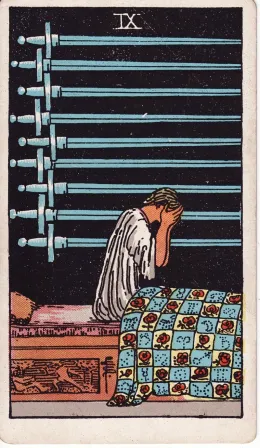
Someone sits up in bed with their head in their hands while nine swords hang flat along the wall. Night magnifies worries until they outgrow their daylight size, so write them down and let morning fact-check them.
Reversed
The worst of the nighttime dread is passing, though tiredness can disguise itself as lingering fear. Naming what actually happened, rather than what could have, helps you take the day back.
What the card shows
A woman sits up on her couch in lamentation, with nine swords mounted on the wall above her. The swords hang flat and orderly, harming no one, while the grief is entirely in the figure beneath them. That contrast is the card's whole argument: the suffering is real, but its arrangement is internal. She is described as one who knows no sorrow like hers, which captures the isolating quality of this state, the conviction at three in the morning that no one has ever felt this way. The card calls it utter desolation, and locates it indoors, in the dark, alone.
Description based on the 1909 edition, in the public domain.
In love
Night has a way of reading a partner's short reply as a final judgment and a friend's silence as an ending. This card sits up with those 3 a.m. rehearsals of every conversation that could go wrong. The people who love you are almost always operating from less malice and more tiredness than the dark suggests; morning usually shrinks the case against them.
At work
Work dread grows loudest at night, when a modest task list swells into a career tribunal. Writing the worries down, each on its own line, converts them from a chorus into a checklist, and most lines look smaller by daylight. Anxiety is a poor scheduler; treat its midnight projections as drafts, not forecasts.
The card’s advice
Keep a notepad by the bed tonight. When a worry wakes you, write it on one line and go back to sleep; in the morning, read the list and cross out anything daylight disproves.
In a yes or no question
Upright, the answer is obscured rather than negative: anxiety is doing the talking, and anxiety always votes no. Postpone the decision to daylight if you can, because the same facts read differently after sleep. Reversed, the dread is receding and the answer becomes reachable; lean toward the option you would choose when rested, not the one you drafted at your most frightened.
The card in a three-card reading
- In the past position
- A period of intense worry lies behind you, and it is worth noting how few of the feared outcomes actually occurred. That ratio is evidence you can use now. The night taught you something about the size of your fears versus your facts.
- In the present position
- You are carrying a worry that grows after dark and shrinks by morning, which tells you its true size is the morning one. Write it down, name it precisely, and let the daylight version of you respond to it instead.
- In the future position
- A stretch of anxiety is possible ahead, most likely around a matter you cannot fully control. Prepare the countermeasure now: sleep, paper, and one trusted person. The fear will arrive loud and leave quietly if you refuse to negotiate with it at night.
Combinations with other cards
Nine of Swords + Ten of Swords
The dread and the ending sit side by side. Together they often mark the final night of a long worry, where the mind rehearses disasters just before the matter actually closes. The pair's message is plain: the fear peaks last, right before it loses its subject. Endure the rehearsal without treating it as a preview.
Nine of Swords + The Moon
Two cards of the nighttime mind reinforce each other's warning. Together they describe a stretch where perception itself is unreliable, colored by fear and half-seen shapes. The advice of the pair is consistent: do not decide, confront, or confess anything important after dark. Morning is part of the remedy, not just the schedule.
Other cards
Text: Marina Vidal, tarot reader · How we write the meanings · Meaning of all 78 tarot cards